
In recent years it has become more and more difficult for me to get my hands on transformers with iron cores. Local "boy's-toys" shops have stopped selling them. The technical hobby shop Clas Ohlson now only sell a 230V to 12V (single winding) at 200mA (only 2.4 Watts @ $10 each!!). Gone are the old 6-0-6 Volt, 9-0-9 Volt and 12-0-12 Volt transformers. So if I want something else I am stuffed. I can go to "professional retailers", but they always seem to want ridiculout prices, often up to $100 for a simple 12-0-12V @ 3 Amperes. They are even hard to get from China, where most power units now use Switch-Mode technology - it is a lot cheaper for manufacturers.
I did find some transformers on fruugo.com and banggood.com for only $5 each 😊, but then I saw the postage was $50 ☹️. What's more is that if you buy 10 pieces then they want 10 x $50 for the postage! 🙁🙁. If that is not enough, they are only rated at 2.5 Watts 😢😢. What blooming use is that?
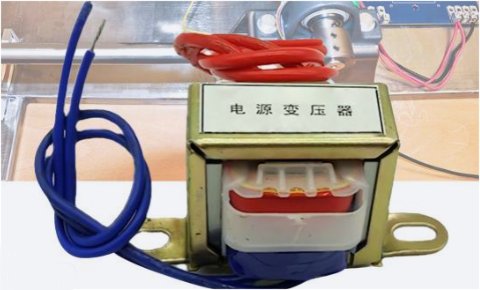
There is some good news. I have visited a couple of those charity shops where they sell used shoes, babies bottles, used dresses and chipped glass and porcelain. There you can often pick up old power units for $1 to $2 each. You know the ones, they give 24VAC @ 20W to power Christmas lights, battery chargers or power units for older domestic radios. If the power unit is light-as-a-feather then it is an electronic SMPSU that is just about useless, unless you just want the fixed voltage that it may deliver. If it is a decent 500g paperweight or "boat-anchor" for a model boat, then they have an iron transformer in them. Those are the beasties I am trying to find.
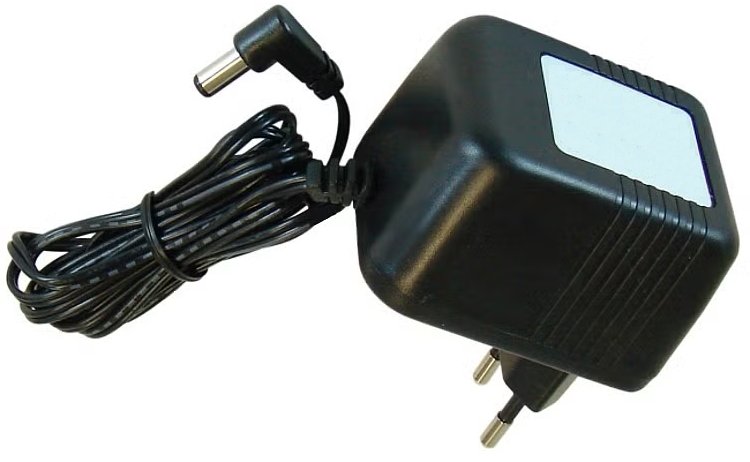
Source #1
These transformers usually have two winding on two bobbins. One is a fixed primary (230V or 115V) and a second bobbin for the secondary winding. You can usually remove the mounting shroud, (gently) knock out the E's and I's, then re-wind the secondary bobbin for whatever voltage you want.
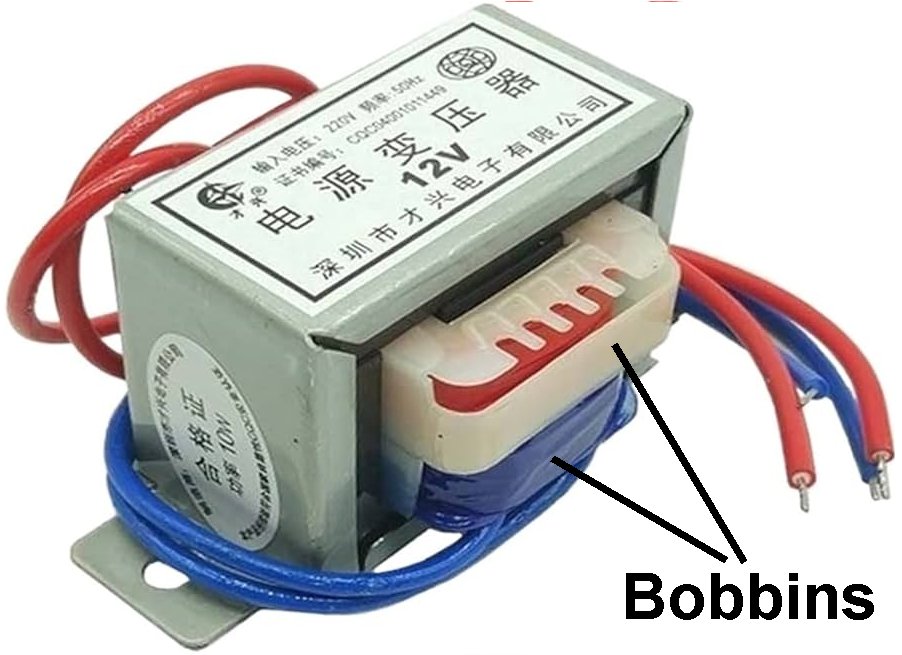
Source #2
Another source is 220 VAC to 110 VAC auto-transformers ($8) (google for "voltage converters"). These need 50Hz (60Hz) input and deliver 50Hz (60Hz) output. These are not economically viable to use SMPSU technology, so they nearly always contain iron 😊. They come in ranges from about 20 Watts to 500 Watts. There is a caveat: they are auto-transformers. They are a single winding, which you can use as the primary for 230V or 115V, then add your own secondary. In addition, the transformer core is normally rated at 8x the actual core material power handling. This because most of the output power comes from the primary, since it is an auto-transformer, just like an HF BALUN. These transformers you can get from joom.com, fruugo.com or banggood.com
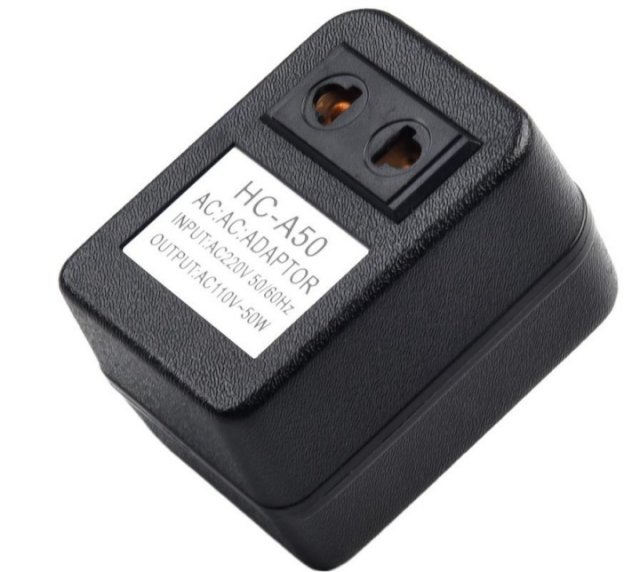
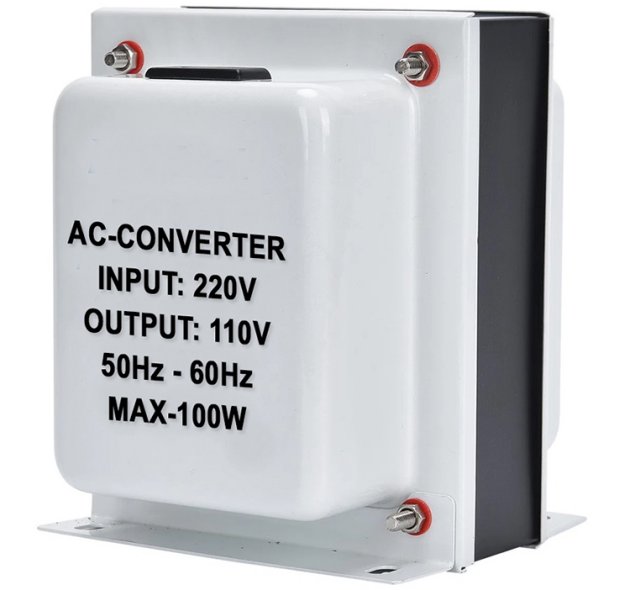
With auto-transformers the 230V or 115V are used for input alternatives. They only have a single bobbin, so you need to put additional wire over the existing wire with good insulation between them.
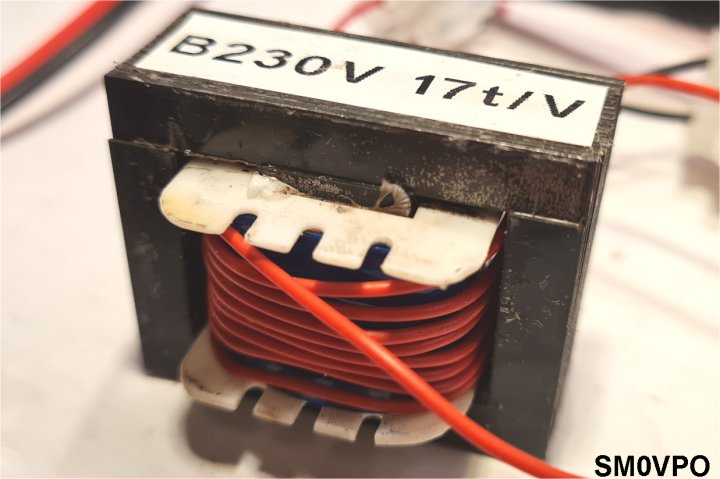
Now you have got your transformer core with a ready-wound primary, all you need do is evaluate it. What will it do?. Begin by taking some single-strand, insulated jumper wire and put 10 turns of wire as a temporary secondary, as shown in the photo above. Plug it into the power outlet and measure the voltage across your secondary. Be careful here, many multimeters use a detector diode that drops 0.15 or 0.7 Volts on the AC ranges, so I also checked it with an oscilloscope. I got 0.588 volts. That means 0.0588 volts per turn, or 1 / 0.0588 = 17 turns per volt. As an auto-transformer it is (over) rated at 20 Watts, but as a conventional transformer it is about 2.5 Watts.
I want 12VAC, so I need 12 x 17 = 204 turns of wire for my 12VAC transformer.
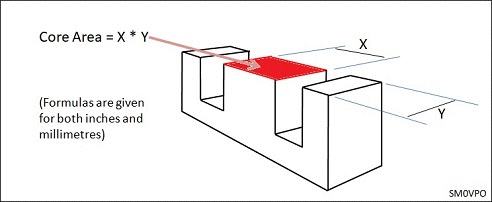
Next, measure the core size to determine how much power you can get out of the transformer:
| --- |
Voltage
Remember that when you calculate the number of turns for a specific voltage, the AC voltage is "that AC voltage that will do the same amount of work as the equivalent DC voltage". This is the "Root-Mean-Square" (RMS) voltage. Since Vpk = Vrms x √2, then 10VAC will give you 10 x √2 = 14.4142136 volts peak. If you use a full-wave bridge rectifier (using silicon diodes), then you will loose 1.4V in the rectifier, leaving you with 13.014 Volts DC across the reservoir capacitor. If you are to provide power for, say, a 10 Volt radio, then you need to calculate your secondary voltage as Vrms = ( 1 / √2 ) plus 1.4V. To get exactly 10 Volts from the rectifier you would need to calculate the winding to give you 10 x 0.70711 + 1.4 = 8.4711 Volts RMS from your winding. It means you will need less wire.
Bobbin Transformers The primary and secondary bobbins are usually about the same size, so you can just select the correct size of wire for the current and start winding. Easy 😊, As long as you do not use wire that is too thick or too thin, then you should have sufficient space.
Auto Transformers
You will probably find that the primary winding fills about 2/3 of the available winding area of the transformer. This means that if I were to select the correct size wire for the current I need, then there is insufficient space. I will need thinner wire, which will reduce the current availabity somewhat.
My 12 Volt transformer, at 204 turns, has only 3mm x 18mm = 54mm² of available space. Assuming I wind really carefully, I can only use 0.25mm wire. This will limit my maximum, continuous (average) current to 147mA, which is 1.764 Watts. For audio amplifers and radios this is not a problem. But for charging batteries I will not get the full 2.5 Watts from the transformer. However, if I look at the Vrms to Vpeak values of the voltage, then I only need 9.89 Volts RMS, at 17 turns per Volt = 168 turns. If I am VERY careful with the winding I may be able to use 0.3mm wire, rated at 212mA = 2.5 Watts. "Being careful" with the winding means winding in neat layers WITHOUT turns overlaping other turns. This is not as easy as you think, and it can take you twice as long to wind the secondary winding.
Wire Size Chart
Here is a table showing wire sizes in Diameter (mm), SWG and AWG. It also shows you the maximum current carrying capacity:
| Diameter (mm) | SWG | AWG | I-maximum (mA) | Length per 100g reel |
|---|---|---|---|---|
| 0.05 | 47 | 44 | 3.8 | 8200 |
| 0.10 | 41 | 38 | 24 | 1400 |
| 0.15 | 38 | 35 | 54 | 620 |
| 0.20 | 36 | 33 | 75 | 438 |
| 0.25 | 33 | 30 | 147 | 227 |
| 0.30 | 31 | 29 | 212 | 157 |
| 0.35 | 29 | 27 | 288 | 118 |
| 0.40 | 27 | 26 | 377 | 88 |
| 0.45 | 26 | 25 | 476 | 69 |
| 0.50 | 25 | 24 | 585 | 56 |
| 0.60 | 24 | 22 | 849 | 39 |
| 0.70 | 22 | 21 | 1150 | 29 |
| 0.80 | 21 | 20 | 1490 | 21 |
| 0.90 | 20 | 19 | 1850 | 18.5 |
| 1.00 | 19 | 18 | 2350 | 13.5 |
| 1.50 | 17 | 15 | 5250 | 6.3 |
| 2.00 | 14 | 12 | 9350 | 3.4 |
One problem with re-using cheap transformers is having the laminations isolated from each other. If any of them short then you get a "shorted turn", which can make the transformer get quite warm, and increase the quiescent (no load) current. These laminations are "E" and "I" shaped, and are sequentially inserted in opposite directions. The laminations are oxidised, or plated, to make one side an insulator, but this is no guarantee.
If you have a really cheap transformer, or if you disassemble the transformer to wind the bobbin, then it is vital that you insert the laminations correctly and all facing the same way, so that the oxidisation or plating is at the same side of ALL laminations. I have previously sprayed laminations with a very thin lacquer to protect them, which also cured the odd rogue transformer that tended to run hot.
Thank you very much for paying a visit to Harry's Homebrew Homepages and for reading as far as this. I hope that this project has given you some "food for thought". You can always e-mail me at harry.lythall@[my domain].com. You can even use hotmail@sm0vpo.com (not a tipping error) or british.inteligence.sweden@sm0vpo.com (not a spellling error), as they are both valid e-mail accounts for me 😉, although I would prefer that you visit my messageboard if you have any questions about this or any other project. I always look forward to receiving feedback, whether it be positive or "constructive" 😊

Very best regards from Harry Lythall
SM0VPO (QRA = JO89wo), Märsta, Sweden.